
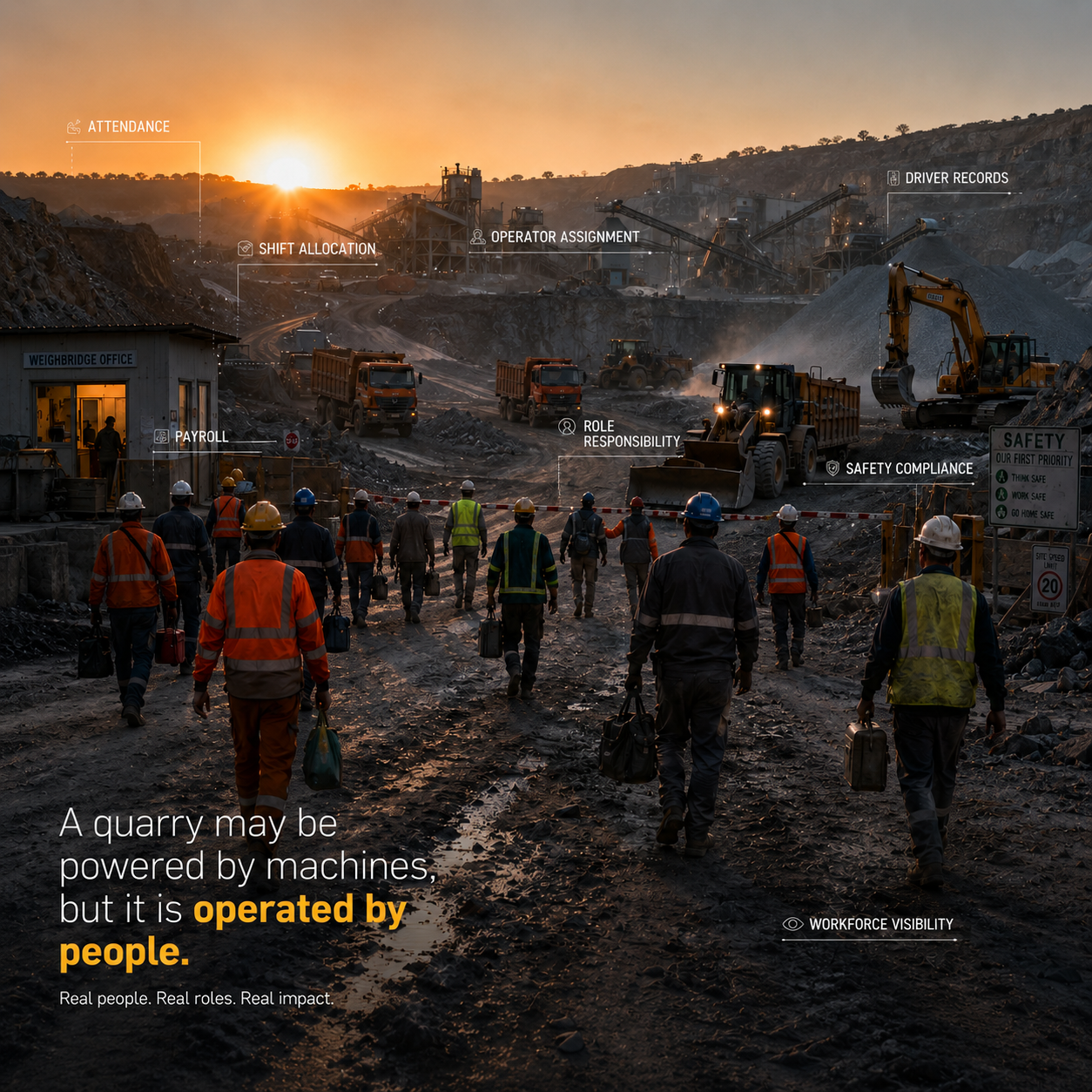
In the aggregate and mining industry, operational focus is almost universally directed toward physical assets. We measure the crushing capacity of the cone crusher, the payload of the dump trucks, the fuel efficiency of the excavators, and the accuracy of the weighbridge. From a distance, a quarry appears to be a strictly mechanical enterprise of steel, stone, fuel, and automation.
However, a closer diagnostic look reveals a different reality. Before a single belt starts moving, the operation relies on a complex synchronization of human resources. Operators must be assigned, drivers must be cleared, mechanics must prioritize assets based on production schedules, and dispatch teams must coordinate customer demands.
While the machinery performs the physical work, it is the workforce that engineers the operational rhythm.
At Onemodo Technologies, we believe that workforce management is not merely a secondary HR requirement; it is a foundational pillar of operational discipline in high-stakes industrial environments.
The Interdependency of Human Action and Operational Continuity
In a quarry, human effort is geographically distributed yet operationally sequential. An issue in one node immediately creates friction down the line.
The industry does not function via isolated individual efforts; it relies on process flows. If the weighbridge operator is delayed, dispatch slows down. If a specific machine operator is absent, a critical asset sits idle, reducing production yield. If shift handovers are clumsy, maintenance schedules slip, leading to reactive repairs and costly downtime.
Every human touchpoint—from the mechanic under a loader to the accountant in the back office—must be viewed as a data point that either accelerates or bottlenecks the production cycle.
Translating Attendance into Operational Capacity
Attendance is frequently relegated to administrative tracking for compliance. In a disciplined operation, however, attendance data is the first measure of that day’s operational capacity.
“Machines create capacity. People create continuity. Great systems respect both.”
— Super Administrator
It is not merely about who is on site, but whether the business has the specific human expertise required to execute the planned production. A gap in key personnel (e.g., a certified blaster, a skilled mechanic, a supervisor) without immediate visibility leads to reactive decision-making.
A centralized, integrated attendance system does not just record presence; it verifies readiness to execute the production mandate.
Shift Discipline as a Tool for Cost Control and Continuity
Aggregate production rarely follows a standard 9-to-5 schedule. Demand, machine availability, and environmental factors dictate complex, rotating shifts.
Poor visibility into shifts creates significant operational risks:
Asset Underutilization: Idle machinery due to labor scheduling gaps.
Fatigue Management: Compromised safety standards due to excessive overtime without oversight.
Cost Creep: Uncontrolled and inaccurate overtime calculations inflating the Cost Per Tonne (CPT).
Operational continuity demands that shift planning is not viewed as a schedule, but as a strategic commitment of resources. True discipline requires an understanding of precisely when people worked, where they worked, the asset they were responsible for, and how their shift performance influenced the day’s output.
Beyond Administration: Data-Driven Performance and Accountability
To scale a quarrying operation, the workforce must evolve through feedback and responsibility. Technology should not reduce people to numbers; it should equip management to identify patterns, optimize allocation, and foster a culture of accountability.
Furthermore, operational integrity depends on a clear demarcation of authority. A robust system ensures that the individual recording attendance is not the one approving payroll, and the driver cannot override the dispatcher. Defined digital roles reflect established physical responsibilities, ensuring transparency and reducing the risk of internal leakage.
The Modomines Approach: HR as an Integrated Operational Core
Within Modomines, Onemodo’s flagship quarry and crusher ERP, HR is not treated as an isolated administrative silo. It is fully engineered into the enterprise ecosystem alongside production, dispatch, maintenance, fleet, and accounting.
When your workforce management is integrated, rather than siloed, the entire operation gains visibility:
Verified Payroll: Modomines ensures payroll is derived from cross-verified operational data—actual attendance and approved shifts—protecting dignity through accuracy and the organization from error.
Integrated Scheduling: Workforce availability is mapped against production and dispatch requirements, ensuring assets are manned and optimized.
Operational History: Full historical tracking provides continuity, allowing management to analyze operator performance against machine fuel efficiency or maintenance response times.
The result is not just better employee records. It is a precise understanding of the human structure powering your production.
Behind every ton of aggregate crushed, loaded, and dispatched, there is a person. Modomines ensures that their contribution is visible, organized, respected, and above all, optimized to drive the operation forward.