

Before a road can be laid, a bridge erected or an apartment tower raised, something much less visible must happen. Stone must be extracted. Boulders must be crushed. Sand and aggregates must travel from distant production sites to places where cities are being built.
For decades, this movement was treated as an ordinary industrial process. Quarry operators obtained permissions, paid royalties, dispatched trucks and maintained the records required by local authorities. Government intervention generally appeared at identifiable moments: lease approval, environmental clearance, inspection or royalty collection.
That model is beginning to change.
Across Karnataka, Tamil Nadu, Meghalaya and Maharashtra, governments are intervening at entirely different points in the mineral supply chain. One state is examining what quarries may have extracted over the past two decades. Another is temporarily preventing construction materials from leaving its borders. A third is reconsidering how legitimate operators obtain and renew permissions. A fourth intends to monitor imported sand trucks in real time.
These initiatives do not constitute a single national policy. They have emerged from different shortages, political pressures, court directions and revenue concerns. Yet, viewed together, they reveal a common movement: construction minerals are entering an era of continuous administrative visibility.
The quarry is no longer being judged only by the licence hanging in its office. It is increasingly being judged by satellite images, drone measurements, vehicle routes, digital permits, production quantities, destination records and the consistency of evidence accumulated over many years.
Karnataka Looks Backward
Karnataka’s emerging royalty-recovery programme is the most financially consequential of the policies examined. The state is pursuing a One-Time Settlement scheme intended to recover historical royalty dues reportedly associated with quarrying between 2005 and 2023.
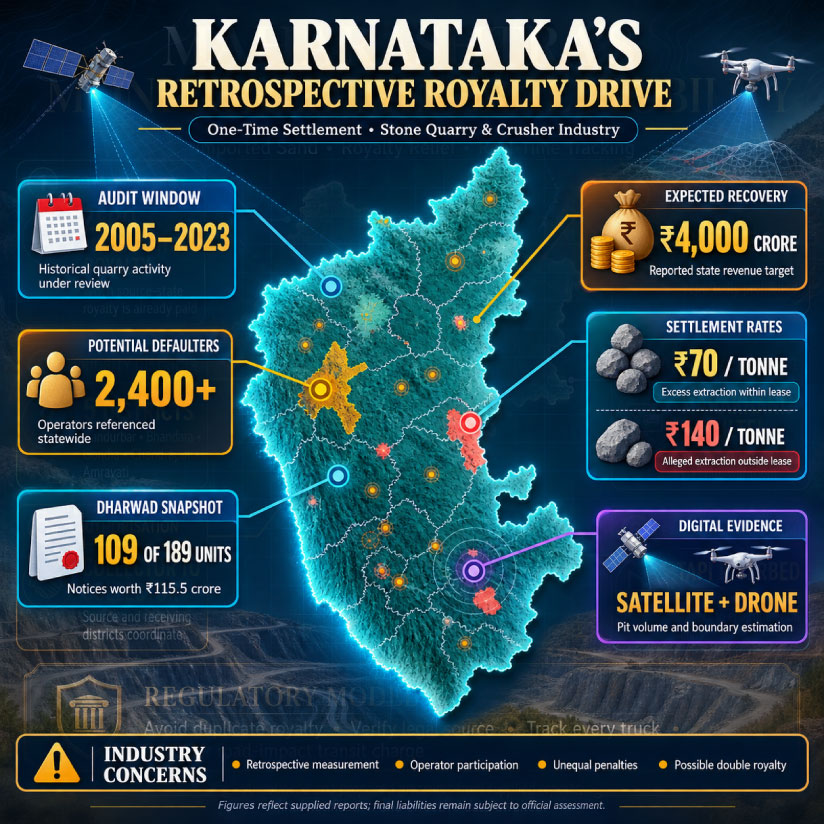
According to the supplied reports, the government expects approximately ₹4,000 crore through this exercise. More than 2,400 quarry operators have been described as potential defaulters, although the final number and liability applicable to each operator will depend on the government’s assessment process.
The programme attempts to solve an old administrative problem with new technology. Officials have argued that the state did not previously possess a dependable mechanism for measuring the quantity of stone removed from individual quarries. Historical satellite images and more recent drone surveys are therefore being used to reconstruct the physical expansion of quarry pits.
In principle, the reasoning is straightforward. If a quarry’s surveyed excavation volume exceeds its permitted or declared production, the difference may indicate unpaid royalty. If excavation extends beyond the approved lease boundary, the state may treat the material as unauthorised extraction.
The reported settlement structure distinguishes between these situations. Excess material extracted within an authorised lease area may be assessed at ₹70 per tonne, while extraction attributed to land outside the approved boundary may attract ₹140 per tonne.
Dharwad offers a glimpse of the programme’s scale. Of the district’s reported 189 crusher units, notices have already been issued to 109, collectively demanding approximately ₹115.5 crore. The remaining units may also receive notices after technical assessment issues are resolved.
For quarry owners, however, the controversy is not simply about the royalty rate. It concerns the credibility of reconstructing twenty years of commercial activity from aerial measurements and then assigning responsibility to whoever currently holds the lease.
Industry associations argue that drone surveys were conducted without adequate participation by operators. They question whether the measurements accurately distinguish permitted excavation, earlier activity, overburden removal, geological variation and material extracted by previous leaseholders.
There is also a dispute over possible double recovery. Quarry and crusher associations say royalty is frequently deducted when government departments settle contractors’ bills. If those deductions were already made, they argue, demanding the same royalty again from the mineral supplier would be inequitable.
These objections have turned a revenue programme into a wider debate about digital evidence. Drone imagery may show that the physical landscape changed, but converting that change into a legally defensible quantity, date, operator and financial liability requires more than a photograph.
Karnataka therefore represents a warning to the entire industry. Operational records are acquiring a life far beyond their original accounting purpose. Production reports, dispatch quantities, weighbridge records, lease maps and royalty payments may eventually be required to explain the physical condition of a quarry many years later.
Tamil Nadu Draws a Border
Where Karnataka is looking backward, Tamil Nadu is attempting to control what leaves the state today. The government has imposed a three-month restriction on transporting rough stone and construction aggregates to neighbouring states, while exempting Puducherry and Karaikal.
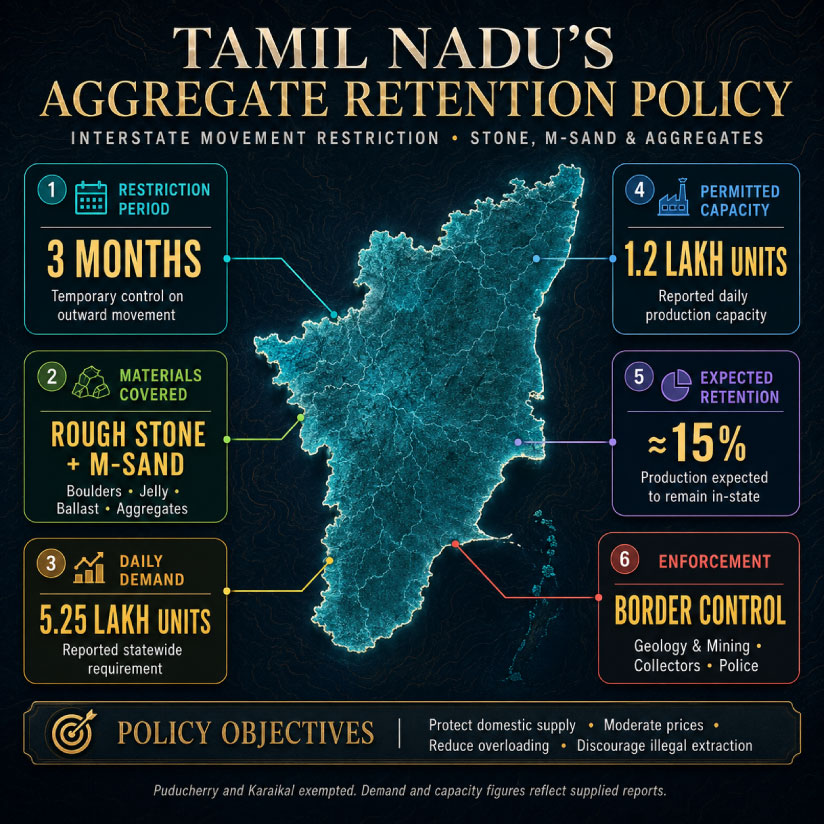
The restriction reportedly covers rough stone, boulders, M-sand, metal jelly, ballast and other materials used in buildings and roads. It has been introduced through an amendment to the state’s rules governing illegal mining, mineral transportation, storage and mineral dealers.
The government’s central argument is one of domestic necessity. Tamil Nadu’s continuing urbanisation, infrastructure construction and housing activity have increased demand for aggregates. At the same time, substantial quantities produced in border districts have been moving into adjoining markets.
The imbalance described in the reports is striking. The state’s estimated daily requirement for M-sand, P-sand and other aggregates is approximately 5.25 lakh units, while permitted production capacity is stated to be only around 1.2 lakh units a day.
These are reported industry and official estimates rather than independently verified measurements. Nevertheless, they illustrate the scale of the policy problem: legally permitted production appears substantially lower than the material being consumed by the construction economy.
Some accounts allege that nearly 60 per cent of Tamil Nadu’s aggregate demand is being met through illegal or unrecorded extraction. If accurate, that would represent not merely an environmental problem but also a significant loss of royalty, GST and other public revenue.
By stopping interstate movement temporarily, the government expects roughly 15 per cent of production to remain available within Tamil Nadu. Projects undertaken by private developers, the Public Works Department, state highways authorities and national agencies could consequently receive more material.
The decision may also weaken local cartels and reduce the incentive for excessive extraction. When legal supply is dramatically lower than actual demand, regulatory violations can become embedded in the ordinary functioning of the market. Increasing domestic availability may ease that pressure, even if it cannot eliminate illegal mining by itself.
Industry opinion remains divided. Some quarry, crusher and lorry operators argue that the restriction unfairly characterises legitimate businesses as contributors to illegal mining. Operators in border districts are particularly exposed because neighbouring markets may form an important part of their established customer base.
Transport representatives supporting the measure believe it could reduce overloaded trucks and unauthorised mineral movement. The government has additionally cited damage to local roads, congestion and ecological pressure as reasons for restricting outward transport.
The consequences extend beyond Tamil Nadu. Construction projects in Kerala reportedly depend upon stone aggregates arriving from Tirunelveli, Tenkasi and Kanniyakumari. Any extended restriction could affect highway schedules, port connectivity and material prices across the border.
Tamil Nadu’s experiment therefore raises a larger question. Is a construction mineral an ordinary tradable commodity, or can a state temporarily reserve it for its own development? As infrastructure demand rises across India, similar conflicts between producing regions and consuming regions may become more frequent.
Meghalaya Reconsiders Permission
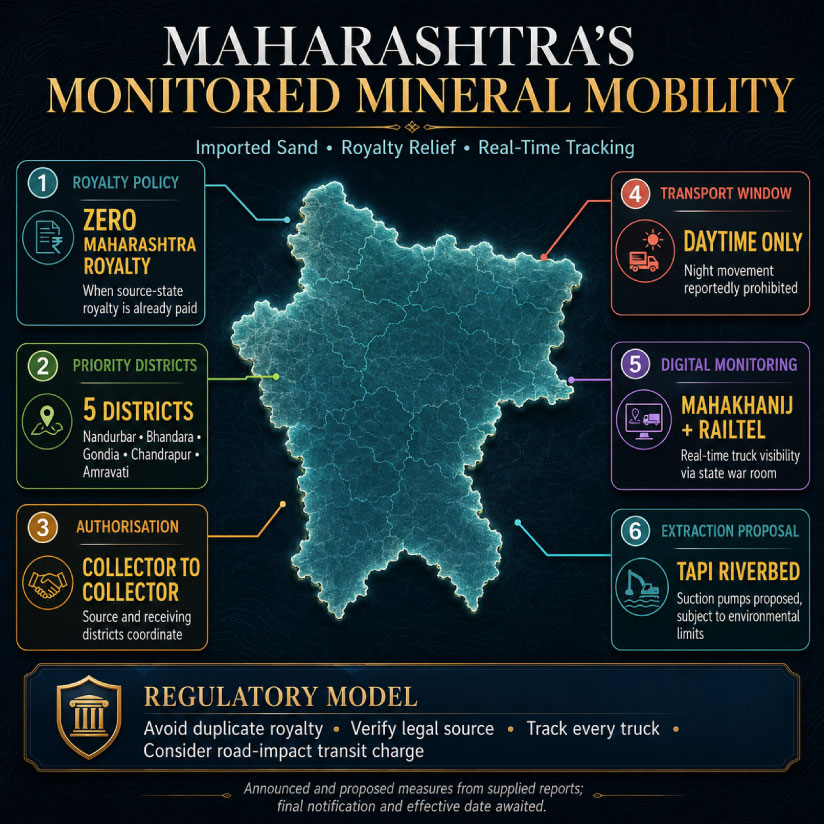
Meghalaya’s policy challenge is different. Here, the central issue is not historical royalty recovery or interstate supply. It is the practical functioning of permissions under the Meghalaya Minor Mineral Concession Rules, 2016 and the Meghalaya Minor Mineral Storage and Transportation Rules, 2022.
Recent court directions have intensified scrutiny of quarrying, crushing, storage and transport. Legitimate operators say they support environmental protection and action against illegal mining but contend that complicated documentation and approval procedures have made lawful operations difficult.
Representatives of quarry owners, crusher operators, transporters and workers have asked the state government to simplify these procedures. Their argument is that regulation must distinguish between operators attempting to comply and those deliberately working outside the law.
The livelihood dimension is significant. Quarrying supports not only leaseholders but also crusher workers, machine operators, truck drivers, mechanics, small suppliers and families in mineral-producing districts. When permissions are delayed or rules are unclear, the disruption travels through this entire local economy.
The government has reportedly constituted a committee to study implementation problems and recommend practical, legally sustainable changes. Any recommendations will have to respect judicial directions while maintaining environmental safeguards and transparency.
Questions raised in the Meghalaya Assembly show why procedural visibility matters. Legislators sought information on applications received, approvals granted, applications pending at different stages, rejected requests, inspection frequency and the distribution of legal quarries.
The government was able to provide district-level figures for Consent to Operate permissions but did not immediately possess every piece of requested application data. The discussion consequently exposed a familiar weakness: the rules may exist, but the complete administrative journey of each application is not always visible from a single system.
The reported enforcement figures are also notable. West Garo Hills was said to have 59 legally operating quarries with valid licences and CTOs. Seventeen illegal-quarrying cases were reportedly registered during the period under review, with the relevant sites closed and penal action initiated.
Meghalaya’s future direction is therefore likely to involve two parallel objectives: stronger action against illegal operations and a more navigable approval process for legitimate enterprises. Achieving both will require transparent application tracking, document validation, renewal alerts, inspection records and clear reasons for administrative decisions.
Maharashtra Follows the Truck
Maharashtra’s announced initiative begins not at the quarry pit but at the state border. The government intends to introduce zero Maharashtra royalty on sand legally imported from neighbouring states when royalty has already been paid at the source.
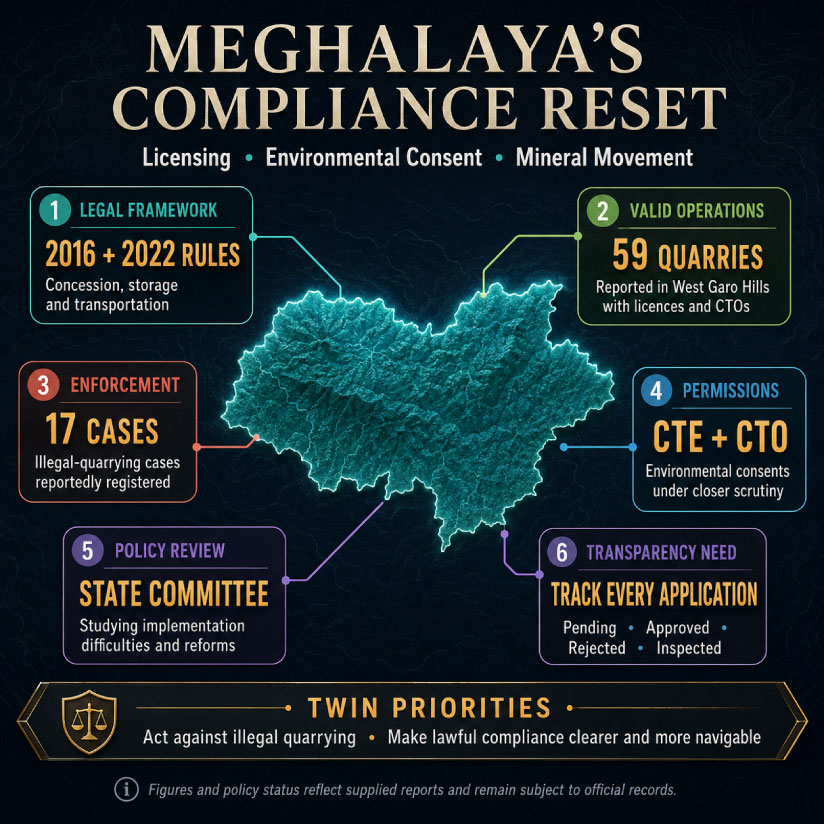
The proposal is intended to address shortages affecting construction and housing projects, particularly in districts such as Nandurbar, Bhandara, Gondia, Chandrapur and Amravati. Districts with sufficient local resources may not receive the same treatment.
Zero royalty does not mean uncontrolled movement. Imports would reportedly require formal coordination between the District Collector of the supplying state and the Collector of the receiving Maharashtra district. The originating authority would need to certify the availability and legality of the material.
Transportation would be allowed only during daytime. Night movement would be prohibited, improving the ability of enforcement personnel to inspect vehicles, verify permissions and detect diversions.
The state is also considering a separate transit charge to fund the repair of rural roads damaged by heavy mineral trucks. Imported sand may therefore be exempt from duplicate royalty while remaining subject to transport-related charges and operational restrictions.
More important is the proposed monitoring architecture. Maharashtra reportedly intends to use the Mahakhanij platform, RailTel infrastructure and a state-level war room to track the movement of every covered sand truck in real time.
This turns mineral transportation into a visible digital event. A truck would no longer be represented merely by a paper permit. It could be associated with a declared source, authorised quantity, dispatch time, approved destination, vehicle identity and observable route.
The government is separately preparing a proposal to permit suction-pump extraction from the Tapi riverbed in Nandurbar, following a model used in the Konkan region. Any extraction would remain limited by environmental approvals.
For the stone-aggregate industry, the significance extends beyond sand. Once real-time monitoring becomes normal for one minor mineral, the same infrastructure can potentially be expanded to rough stone, M-sand, crusher products and other regulated materials.
From Operation to Evidence
Taken together, these four states reveal four different forms of government attention. Karnataka is reconstructing excavation. Tamil Nadu is restricting outward supply. Meghalaya is examining permissions. Maharashtra is following transport.
The common denominator is evidence.
A modern quarry may increasingly need to demonstrate that its physical extraction matches its lease, that its production matches its dispatches, that every truck carried an authorised quantity, that royalty was paid once and correctly, and that every alteration to a transaction can be explained.
This changes the role of quarry software. An ERP can no longer be treated only as a tool for generating invoices, managing customers or printing weighment slips. It must become an operational memory capable of defending what happened.
For Modomines, the opportunity is not to imitate government portals. It is to create a reliable evidence layer within the quarry: one that connects production, weighment, dispatch, GPS movement, permits, royalty calculations, customer records and changes made by individual users.
A weighbridge transaction should be more than a weight. It should connect the vehicle, customer, material, permit, loading point, destination, timestamp and supporting images. A production entry should be reconcilable with stock movement and outward dispatch. A corrected record should retain its original value and identify who changed it.
The states are approaching regulation from different directions, but the destination appears similar. India’s quarry economy is moving toward a future in which every tonne must carry a believable history.
For operators, that future may initially feel like greater scrutiny. For responsible businesses, it can also create protection: protection from arbitrary estimates, duplicate demands, undocumented accusations and competition from operations that ignore the law.
The decisive advantage will belong not merely to the quarry that produces efficiently, but to the quarry that can prove—clearly, continuously and years later—exactly what it produced, where it travelled and why every record should be trusted.