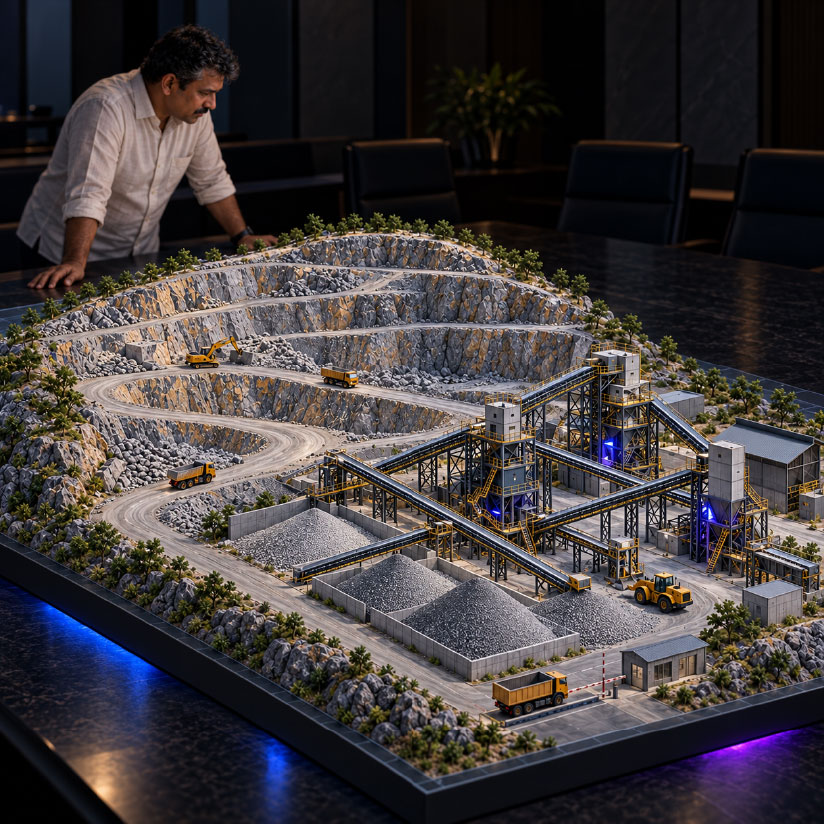

The owner’s decision
Decide whether to own a quarry, operate a crusher using purchased stone, or run an integrated quarry, crusher and delivery business. A quarry-only operator must manage extraction and source dispatch. A standalone crusher depends on outside supply. An integrated owner must coordinate the pit, plant and customer pipeline. Adding a stockyard or fleet introduces another custody point and another cost centre.
“Ownership begins with knowing which material, obligation and rupee belongs to your business.”
— Super Administrator
First, you must build a commercial case around recoverable material (such as aggregates), accepted products, customers and delivered cost. Consider access, power, water, drainage, labour and space for stock. Budget for the interval between paying for fuel and receiving customer money. Before the first movement, establish separate identities for each legal entity, site, store and stock location. This gives theft prevention a defined boundary: the business can identify what it owns and who holds it.
The evidence needed
Obtain title and access evidence, concession instruments, current surveys, technical assessments, equipment ownership and finance records, supplier terms and credible customer requirements. Distinguish geological resources from material recoverable under the applicable design and permissions. Test the cash plan against lower sales, delayed commissioning, repairs and slower collections. Verify opening stocks and debts independently when buying an existing operation.
The cost of getting it wrong
An attractive purchase price can conceal unusable reserves, access disputes, leased equipment, unpaid suppliers or stock that belongs to someone else. Starting with an inflated opening balance makes subsequent reports look precise while preserving the original error. A merged stock account can also let one site’s shortage disappear inside another site’s surplus.
An acquisition needs a dated handover: counted assets, measured stocks, confirmed balances and an agreed list of unresolved liabilities. Record who accepted each item. Asset misrepresentation, material diversion and innocent opening errors require different responses, but all become harder to investigate after the handover evidence is lost.
The applicable state variation
Confirm the selected state’s mineral classification, concession route, land category, transfer conditions and treatment of quarry, crusher and stockyard activities. Central MMDR legislation provides for state rules governing minor-mineral concessions; it does not establish one national acreage or lease-term assumption. Check the specific parcel and mineral, including any special land or regional restrictions, with the relevant professionals.
The records that support control
The starting software record set such as an entry in Modomines should include site and entity masters, asset identifiers, counterparties, verified opening stock by unit and location, financing obligations, supplier/customer balances and document references. Assign a custodian to physical stock and a different reviewer to opening adjustments. Preserve the original measurement when an adjustment is approved.