The owner's decision
Every owner has to choose how disciplined the money side of the business will be. That means a clear process for invoicing, collections, cash handling, tax reporting and month-end review. Someone needs to own the follow-up on overdue accounts, and it must be obvious when a customer needs approval before getting more credit. Wages, power, fuel, debt and essential maintenance all fall due on fixed dates, so they are planned against receipts that are realistic, not hoped for. A full order book is welcome, but it does not pay the electricity bill.
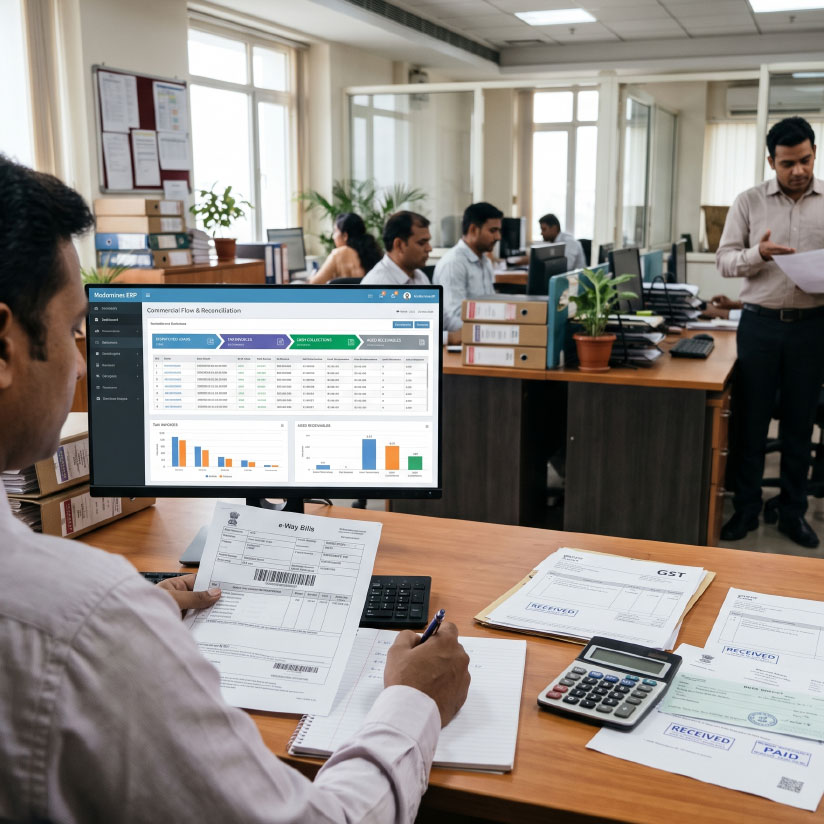
Modomines links the dispatch to the commercial document, then to the customer ledger and the actual receipt. Quantity, price, freight and tax stay separate, so each can be checked on its own. Cash collections are recorded promptly and reconciled to the cashier's custody and the bank deposit. That is where unbilled loads, diverted collections and false credit notes show up, before anyone accepts them as a normal balance.
“A sale is not finished when the truck leaves the gate or the invoice is printed. In the owner’s cash plan, it is finished when the money lands and is reconciled to the right customer.”
— Super Administrator
The evidence needed
The original instruction that royalty passes and GST sales should match has a sound idea behind it. Both should be explainable through the same business history. It does not mean the raw-mineral permit quantity must equal the finished-product invoice quantity. Stock, purchased feed, conversion, timing, returns and transfers can all create legitimate differences.
It helps to keep seven connected views side by side: approved capacity, extraction, mineral transport entitlement, raw stock, processing and finished stock, commercial and tax records, and cash. Entity, site, material, unit and cut-off must line up before anyone judges a difference. Official e-way-bill guidance takes the same view, treating transport documents and invoice or challan details as connected but distinct records.
The cost of getting it wrong
Errors cut both ways. Cash can be collected without reducing the customer's balance, or a false receipt can wipe out a debt while no money arrives. A credit note can hide a diversion. On the other side, an invoice can look overdue only because a genuine payment was posted to the wrong customer. For this reason, Modomines keeps the supporting event and approval behind every correction, so an investigation always has something to follow.
Profit asks for more than a sales figure. It needs opening and closing inventory, material and processing costs, wages, maintenance, finance charges and other relevant expenses. Subtracting the uploaded "Production" report value from the sales report does not establish gross profit, because the role and measurement basis of each remain unresolved. An attractive dashboard number should never override the accounting evidence.
The applicable state variation
Tax rules differ by business and transaction, so check the current tax classification, invoice, e-invoice and e-way-bill applicability, including relevant intrastate provisions. Confirm mineral-specific royalty or seigniorage and other state charges separately.
The records that support control
A well-run file holds the dispatch-to-invoice reconciliation, approved credit and debit notes, customer receipts, cash counts, bank reconciliation, ageing, supplier balances and the accountant's tax reconciliations. Cancelled documents stay tied to the original movement and to any return. Advances are reconciled separately, so a payment is never allocated twice.
Modomines supports a monthly close where unresolved differences stay on the list, each with an owner and a due date. Contribution by product and route is reported only when the costs and their allocation can be defended.