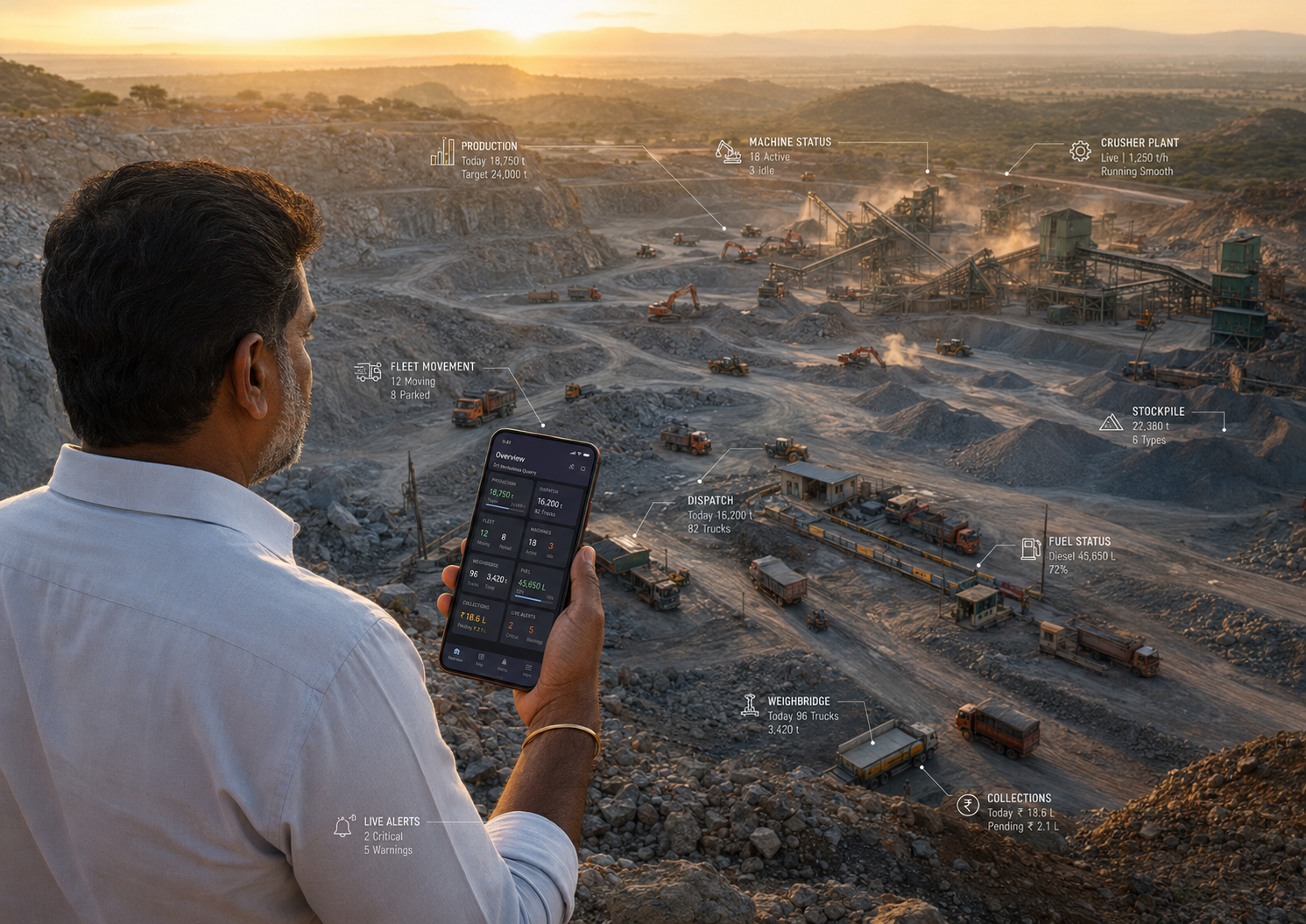
Situational awareness is often associated with pilots, soldiers, emergency workers, and control rooms. It describes the ability to understand what is happening now, and perhaps what may happen next. In high-pressure environments, situational awareness is the foundation for a good judgment.
A quarry and crusher plant owners understand this better than most. Why? Simply because that’s the nature of an industrial plant. Though a business might occupy a fixed place on a map, but its concerns do not remain inside the boundary wall. Customer meetings, banking, tax reviews, machine purchases and sleepless nights. Given these high-pressure environments, situational awareness becomes a foundation for a good judgment.
Leadership roles in a modern quarry and crusher plants demands something more immediate. For decades, plants operated through manual data entry. Reports always arrived next day, registers were reviewed later, supervisors explained what had happened in the past. Owners made decisions using information that was already aging. The reports were useful but limited.
However, in a modern quarry and crusher plants, multiple systems operate at once. Production continues at the crusher. Trucks enter and leave the weighbridge while the fleet vehicles move constantly. Customers place orders and payments that are due are aging. Small changes in one department affect outcomes elsewhere.
No single department operates independently. Production, dispatch, fleets, accounts, machine maintenance, and HR operate interdependent on each other’s efficiency. The owner must know the whole picture in real-time. Not tomorrow. Now.
Mobile apps as an Extension of Leadership
This is where the meaning of mobile access changes. A mobile application is often described as a convenience, but for an industrial setting, it becomes something far more important. It becomes an extension of leadership. It allows responsibility to remain connect to reality at all times even when the owners are NOT physically present at the site.
“Knowing what happened yesterday is reporting. Knowing what is happening now is leadership.”
— Super Administrator
The phone does not replace the quarry visit. It does not replace supervisors, managers, accountants, operators, drivers, or mechanics. It does not replace experience. However, it extents visibility. A quarry owner sitting in Chennai, Coimbatore, Bengaluru, Hyderabad, or anywhere else should not have to wait until evening or the next day to understand what is happening to their business.
If production slows, if the dispatch increases, or if a machine moves towards service requirement, then the owner should know immediately. Situational awareness should not depend on physical presence, rather it should travel with responsibility.
Dashboards Should Provide Clarity Over Complexity
The most powerful dashboards are the ones that reduce complexity. A good operational view should not overwhelm the owner with data but it should help the owner understand the pulse of the business immediately.
Important data points such as production data, real-time sales figures, cash-flow statements, fleet movements, pending payments must be immediately understandable in a few thoughtful moments spent on looking at the dashboard. The purpose of a powerful dashboard is to know where the attention is required.
There is another important difference between ordinary reporting and situational awareness. If the production is below target, the question is not merely how much was lost, but why the slowdown occurred in the first place and whether future order’s timeline be affected. If a customer delays payment, the issue may not be outstanding balance but if further dispatch should continue without review.
Similarly any delay in truck, or if a machine shows signs of stress information flow must be seamless in such a way that whether future orders will be affected and if so how it can be mitigated in the future. Awareness always turns information into timing. And most of the time timing is often the difference between a manageable issue and an expensive lesson.
The strongest leaders do not need to personally witness every event. They need systems that help them understand which events matter most.