
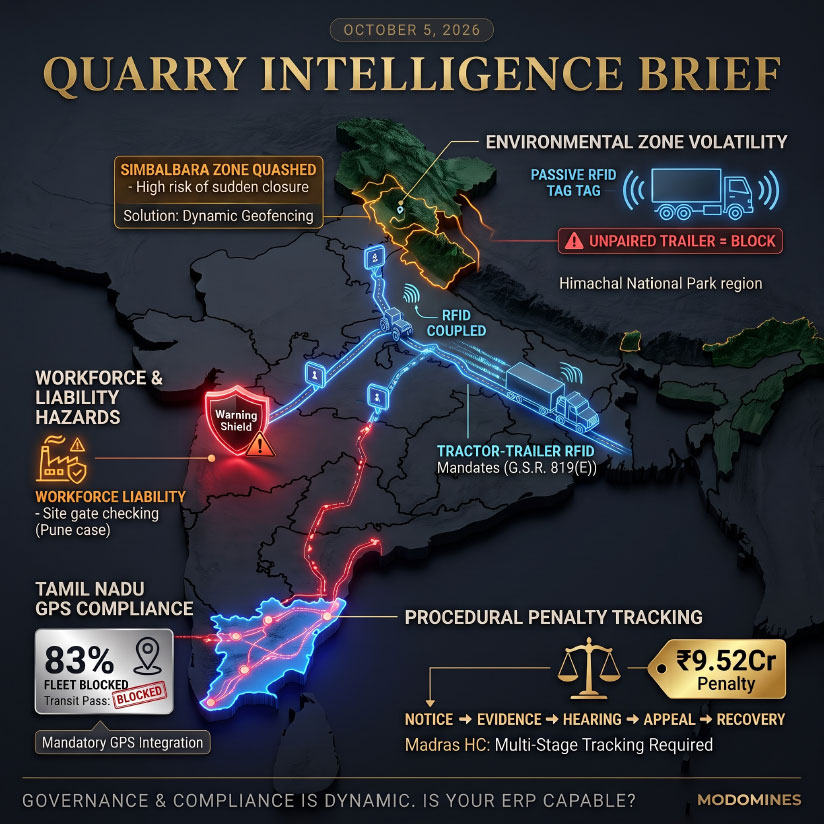
Tamil Nadu activated its GPS-linked mineral-transport restrictions while only about 17% of registered vehicles were reportedly equipped, and a nationwide tractor–trailer tracking rule simultaneously took effect.
1. Tamil Nadu’s GPS requirement is now operational.
Confirmed implementation: From 1 October, Tamil Nadu prohibited mineral transport—including black stone, M-Sand and sand—by vehicles without compliant GPS equipment. Unqualified vehicles can no longer receive or retain the required transport pass. A Tamil Nadu district administration notice confirms the requirement to install GPS and integrate it with MiMaS by 30 September.
Adoption signal: On the cutover date, only 24,000 of approximately 1.4 lakh registered mineral-transport vehicles—about 17%—were reportedly GPS-equipped. This is an improvement over the earlier 9% figure, but still implies a large potential reduction in eligible transport capacity.
How Modomines Helps: Vehicle eligibility will become part of dispatch execution. The operational question is no longer simply whether a truck has GPS, but whether the device is approved, integrated with MiMaS and accepted for permit generation. Contact us for more details.
On a per-need basis customers ability to add MiMaS accepted, devices, approval standards, last transmission through that device and add permit-eligibility fields to the vehicle master data. Customers are advised to introduce a pre-dispatch compliance check for both owned and contracted vehicles. Store the acknowledgement on the portal and device-onboarding requirements as per state laws.
2. Nation-wide tractor–trailer telemetry and RFID requirements takes effect
Under G.S.R. 819(E), issued on 3 November 2025, new Central Motor Vehicle requirements became applicable on 1 October 2026:
- • Non-agricultural N2 and N3 haulage tractors require AIS-140:2016-compliant Vehicle Location Tracking Devices (VLTD).
- • The VLTD must incorporate an IS 16722:2018 RFID transceiver capable of identifying the coupled trailer and reporting the pairing.
- • T3 and T4 trailers require passive RFID tags.
- • Applicable trailers require a 13-pin, 13-pole or higher connector.
- • AIS-220 event-data recorders and updated coupling standards follow on 1 April 2027.
The limitation of the scope is it simply does not automatically cover every tipper or agricultural tractor used around a quarry. Vehicle-category and registration records determine applicability of this law. Why it matters: Fleet records must now distinguish the tractor from the trailer and prove which combination operated during each trip. Modomines helps to maintain an auditable vehicle–trailer–driver–dispatch relationship.
3. Pune crusher fatality exposes contractor-workforce liability
Confirmed allegations under investigation: A 17-year-old worker died on 11 September after becoming trapped in stone-crushing machinery in Pune. On 28 September, police reported booking the crusher owner and contractors, alleging unlawful employment of a minor in hazardous work and absence of essential safety equipment. The case invokes the Bharatiya Nyaya Sanhita, Juvenile Justice Act and child-labour legislation; no arrests had been made when reported.
Why it matters: Generally quarry ERP systems usually treat contractor labour as an attendance or payment problem. Modomines, however it collects all the pertinent data that owners require evidence of worker eligibility.
4. Environmental-zone status can reverse suddenly
Newly reported on 29 September; earlier events disclosed: The Himachal Pradesh High Court quashed the Eco-Sensitive Zone around Simbalbara National Park on 16 April 2026, citing procedural failures and inadequate consultation. Two crushers that had stopped under the 2022 notification were permitted to resume during May–June. The state had not decided whether to appeal or begin a fresh notification process when the development was reported.
A quarry’s operating status cannot be represented by a permanent “environmental clearance: yes/no” field. Boundaries, notifications, court orders, appeals and renewed notifications can change the lawful operating position at any time. Modomines helps make environmental and geographical controls using geo-fencing as needed by the customer.
5. Penalty workflows must preserve procedural stages
The Madras High Court declined to accelerate recovery of ₹9.52 crore in penalties from Tirunelveli blue-metal quarry operators. The state said 28 related petitions were pending and that operators’ representations must be heard before recovery proceeds.
A penalty is not simply “due” or “cancelled.” It moves through notice, evidence disclosure, representation, hearing, interim protection, reasoned order and recovery.